
The Log Is the Product: Tamper-Evident Audit Trails for AI at the Console
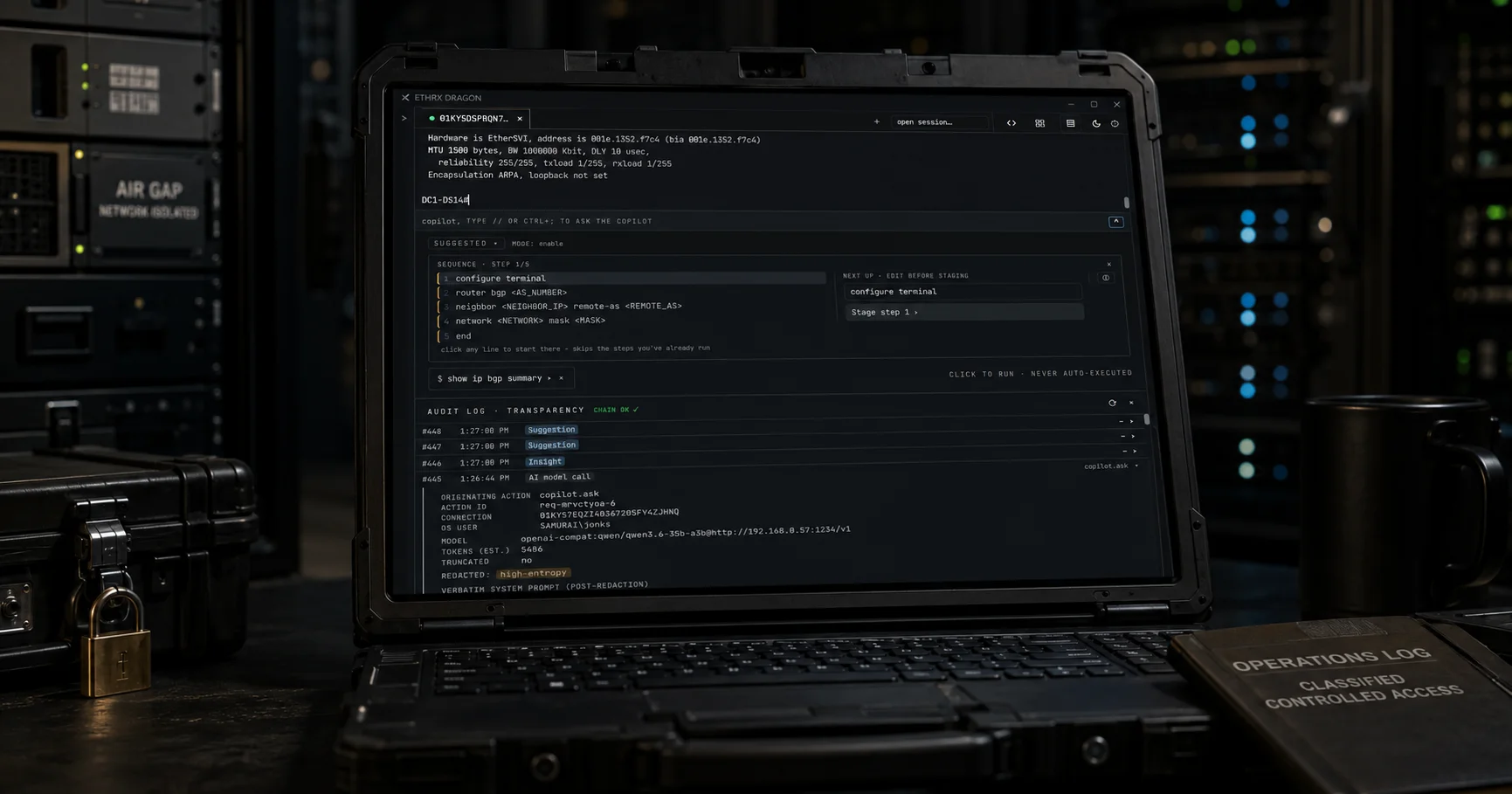
An operator sits down at a jump box in a facility with no uplink, opens an AI copilot, and asks it why BGP is flapping on a core router. The tool reads a stack of configs and baselines, reasons through the symptoms, and stages a fix. The operator approves it. The session ends.
Three weeks later an accreditor asks a question that has nothing to do with whether the fix was correct: what exactly did that tool read, and can you prove it? Which files did it open. In what order. At what time. Whether any credential left the room in the process. If the honest answer is "we think it was fine, but we can't reconstruct it," the tool has failed an audit even though it fixed the router.
This is the part of operator AI that demos skip and regulated environments live or die on. A confident answer is table stakes. In regulated and federal environments — HIPAA, ITAR, CMMC, FINRA — the deliverable isn't just the outcome. It's the evidence of the outcome. DRAGON is built so that the evidence is a byproduct of normal operation, not a forensics project after the fact. This post is about how that works underneath.
Why "trust me" doesn't survive an audit
Most AI tooling treats logging as telemetry: fire-and-forget lines shipped to a cloud aggregator, useful for debugging, worthless as proof. Two problems make that model unusable where accountability actually matters.
The first is egress. A tool that phones home to log has, by definition, moved data off the box — the exact thing an air-gapped or sensitive site is built to prevent. You cannot solve accountability by streaming a record of everything you did to someone else's server. The record itself becomes a leak.
The second is mutability. A plain log file is a suggestion, not a proof. Anyone with write access — or any process with a bug — can append, truncate, or rewrite it, and nothing about the file betrays the edit. An auditor who knows this treats an ordinary log as an assertion, not evidence. "Here are our logs" and "here is proof of what happened" are different claims, and only one of them ends the conversation.
DRAGON answers both by keeping the record local and making it tamper-evident. Nothing leaves the room, and the log is structured so that any after-the-fact alteration is detectable. The record isn't a story you tell the auditor. It's an artifact they can verify themselves.
Hash chaining, concretely
The mechanism behind "tamper-evident" is a hash chain — the same primitive that makes a blockchain's history hard to rewrite, applied to a single operator's session rather than a distributed ledger. The idea is simpler than the buzzword suggests.
Every meaningful event during a session becomes an entry: a session opening, a filesystem read the model performed, a retrieval, a model call, a suggested command, an operator acceptance. Each entry carries a timestamp, a type, and a payload describing what happened. The important part is that each entry also carries a cryptographic hash — and that hash is computed over both the current entry and the hash of the entry before it.
entry[n].hash = SHA-256( entry[n].payload || entry[n-1].hash )
That single back-reference is what turns a pile of log lines into a chain. Because every hash folds in the one before it, the entries are no longer independent — each one commits to the entire history that preceded it. Change the timestamp on entry 341, and its hash changes. But entry 342 was computed using the old hash of 341, so now 342 doesn't match either. So does 343, and every entry after it, straight to the end of the session. A one-character edit anywhere in the past invalidates everything downstream of it.
To verify, you don't need to trust the tool, the operator, or the storage. You walk the chain from the beginning, recompute each hash from the payload plus the prior hash, and check that it matches the recorded value. If every link checks out, the log is intact. If one doesn't, you know exactly where the history was disturbed. The verification is arithmetic, and anyone can run it.
A plain log asks you to trust that nobody touched it. A hash-chained log lets you check — and tells you precisely where if someone did.
This is why the log entries on DRAGON's audit view carry a hash column next to each event: acceptance, suggestion, fs_access, session_open, each with its own digest. Those aren't decoration. They're the links. Select any entry and you can reconstruct exactly what the tool read — which files, when, down to the millisecond — because the entry commits to that content and the chain proves the entry hasn't moved.
Reconstruction is the real feature
Tamper-evidence tells you a record wasn't altered. Reconstruction tells you what the record means. Both matter, and the second is where audits are actually won.
When DRAGON logs a filesystem access or a retrieval, it isn't just noting "the model looked at something." It captures enough to rebuild the model's exact evidence picture at that moment — the specific files, the specific configuration baselines, the specific slice of session history that fed the answer. Reconstruction turns an abstract worry ("could the AI have seen something it shouldn't?") into a concrete, answerable query ("here is the complete list of what it saw, and here is the proof that list is complete").
Consider the two audit failure modes this closes:
- The overreach question. Did the tool read a file outside its authorized scope? Without per-access logging you're reduced to reasoning about permissions in the abstract. With it, you produce the actual access list and let the chain vouch for it.
- The provenance question. Where did this recommendation come from? A suggestion entry links back to the retrievals and reads that informed it. You can trace an approved action to the evidence behind it, rather than asserting the model "probably" used the right docs.
An auditor who can select a line and reconstruct the millisecond-level file access behind it stops asking whether your process is trustworthy and starts confirming that it is. That is the entire difference between an evidence request that closes in an afternoon and one that spawns a remediation cycle — the same standard ETHRX applies when it hands off a secure collaboration deployment: the auditor gets a report, not a project.
The redaction boundary: keeping secrets out of the model
Accountability has a second half that a log alone can't provide. If you're going to feed real production context to a language model — configs, console output, session scrollback — you have to guarantee that credentials, keys, and secrets don't ride along into the model's context in the first place. Logging what the model saw is small comfort if what it saw included the enable password.
DRAGON handles this with a redaction boundary: secrets are stripped before anything reaches the model, not filtered out of its answers afterward. The distinction is everything. Scrubbing outputs is a losing game — you're trying to catch a secret after it's already been ingested, embedded, and potentially reasoned over. Stripping at the boundary means the sensitive material never crosses into the model's context at all. The model can't leak, echo, or embed what it was never given.
raw console / config
      │
      ▼
[ redaction boundary ]   ← passwords, keys, community strings,
      │                    tokens, secrets removed here
      ▼
model context  →  reasoning  →  suggestion
Two design choices make that boundary trustworthy rather than aspirational. First, it's verified by a regression-tested redaction engine — the patterns that catch secrets are themselves under test, so a change that would let something slip is caught before it ships, not discovered in an incident review. Redaction that isn't tested is a hope; redaction under regression is a control. Second, because DRAGON runs entirely on the operator's machine with egress blocked, the boundary sits inside the same trust perimeter as the data. There's no network hop where raw text is exposed in transit to a cloud, no third-party inference endpoint that has to be trusted to forget. The material that gets redacted never had an opportunity to leave.
Put the two halves together and you get a closed loop: sensitive data is stripped before the model sees it, and everything the model does see and do is committed to a chain you can verify. What the model touched is provable, and what it should never have touched, it never got.
Operator in command, on the record
None of this displaces the human. DRAGON suggests commands; the operator reviews and runs them. The tool never acts on a system by itself. The audit trail is what makes that division of labor auditable rather than merely stated — every suggestion and every acceptance is its own entry in the chain, so the record shows not just what was proposed but that a human decided to run it, and when.
That's the property regulated environments are actually reaching for when they ask about "AI governance." Not a model that promises to behave, but a system where the boundary between machine recommendation and human authorization is captured as evidence. The chain distinguishes suggestion from acceptance because the difference is the whole point: the operator remains the accountable party, and the log proves the operator was in the loop.
The takeaway
The hard part of putting AI on a production console was never getting a plausible answer out of a model. It's being able to stand behind what that model touched, in front of someone whose job is to doubt you. An answer you can't audit is a liability wearing the costume of a tool.
DRAGON treats the record as a first-class output: local so nothing leaks, hash-chained so nothing can be quietly rewritten, reconstructable so an accreditor can see exactly what happened, and paired with a tested redaction boundary so secrets never reach the model to begin with. That's what "accountable by default" means — the evidence is a byproduct of running the tool normally, not a scramble after the audit request lands.
This is the same discipline ETHRX brings to every ML integration that runs inside a customer's perimeter and every collaboration platform we hand off audit-ready on the first pass: capability is necessary, but in the environments we build for, provability is what ships. If you're weighing an AI copilot for operators who work where the answer has to survive an audit, the question to ask isn't just how good the answers are. It's whether the tool can prove what it did — and hand you the log to check.