
CHAOS Enters the Army's xTech|Search 10: Proving C2 Before the Fight
Deployable networks rarely fail on the bench. They fail on the move, over degraded satellite, radio and cellular links, when it is too late to fix the plan.
On October 19, ETHRX submitted CHAOS to the U.S. Army's xTech|Search 10 competition. xTech|Search is the Army's open-topic prize competition for small businesses with technology that could change how soldiers operate. Up to 50 semifinalists will be announced in January 2027 and will pitch to Army and Department of War subject-matter experts.
This post explains what we submitted and why we built it.
The problem: units meet DDIL in the field
Every mobile command post, convoy, fly-away kit and expeditionary team depends on links that degrade under real conditions. A MANET gets jammed. A SATCOM hop drops to a trickle. A LEO terminal loses its view of the sky. These are DDIL conditions (denied, degraded, intermittent or limited), and they are the norm in a contested fight, not the exception.
Today, most units have few good ways to rehearse against them:
- Combat Training Center rotations expose units to contested conditions, but they come on a schedule, not on demand, and no two runs are the same.
- Commercial lab emulators are accurate but expensive, specialist-operated, and usually live in program or vendor labs rather than in a unit's motor pool.
- Free tools like Linux netem can impair a link, but they take a skilled engineer to script and leave no trustworthy record of what was tested.
- Doing nothing means the first real test of a PACE plan happens in the field.
The timing makes this urgent. The Army plans to field Next Generation Command and Control (NGC2) to 11 divisions and four corps by FY2032, according to the Government Accountability Office. Follow-on units will have less time to train up than the test divisions had (DefenseScoop). Those units need a way to prove their C2 holds up over contested networks before they deploy, not after.
What CHAOS does
CHAOS is a fanless appliance that installs in-line between any two pieces of network equipment, for example between a command post and its transport. It acts as a transparent Layer-2 bridge, so the systems on either side need no reconfiguration. From there it reproduces the conditions a contested network actually throws at you:
- latency and jitter
- burst packet loss
- rate collapse and bandwidth limits
- reordering and duplication
- full outages
Each condition is set independently in each direction, because real links are rarely symmetric. Time-varying scenarios (a LEO link that degrades and recovers, a SATCOM hop that collapses during a jamming window) run from a recorded seed, so any test can be replayed exactly.
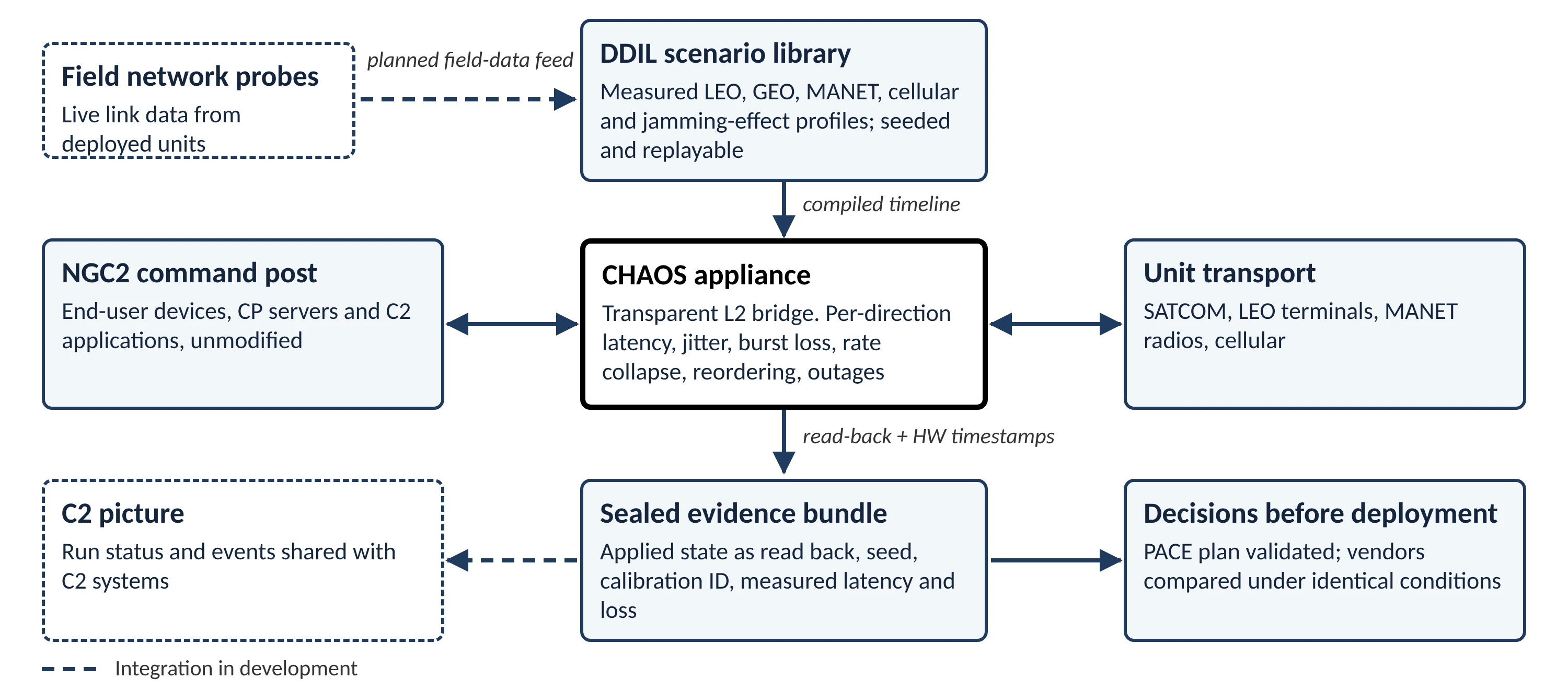
CHAOS sits in-line between command-post systems and their transport, runs DDIL scenarios, and records the conditions it actually applied. Dashed elements are integrations in development.
Four things it changes for the warfighter
1. DDIL rehearsal moves to home station. A signal section puts one box between the command post and its transport and runs scripted contested scenarios against real equipment on any training day, not only during a CTC rotation. CHAOS goes from cable-in to first impairment in under a minute.
2. Results become evidence, not anecdotes. After every change, CHAOS reads back the conditions the system actually applied and records any difference from what was requested. When a unit says its PACE plan held up, or an evaluator says one vendor's system outperformed another's, both can point to exactly what the network did during the test. Every vendor can be measured against the identical, replayable degraded network.
3. Electronic-warfare effects with zero emissions. CHAOS reproduces the network-layer consequences of jamming (burst loss, outages and throughput collapse) without a jammer, a spectrum authorization or a range. Its radios are disabled by default, so it can sit anywhere a unit trains.
4. Built for units, not just labs. CHAOS is priced under the federal purchase-card threshold, so a unit can buy one without a major contracting action. It is built on TAA-compliant, Section 889-clean hardware with signed software releases.
Where CHAOS stands today
CHAOS is at Technology Readiness Level 5. The impairment engine, read-back verification, API, operator CLI and live monitor are validated on our ETHRX-ONE appliance, and live video streams have been carried through it end to end. A July 2026 feasibility test of the built-in traffic engine reached 2.5 Gbps line rate with one-way latency measurement precision of about 100 nanoseconds.
Next comes the work the competition is designed to fund: a scenario library built from measured field data, independent calibration, and a demonstration with an Army lab on real mobile command-and-control networks.
Why ETHRX built it
Before founding ETHRX, I spent seven years as principal network architect at the White House Communications Agency, much of it testing mobile communications over cellular and satellite links that had to work the first time. CHAOS is the tool I wanted then: a way to know how a mobile network will behave when it is degraded, before anyone is relying on it.
ETHRX is an SBA-certified, veteran-owned small business, and CHAOS has been built entirely with company funds. We will share updates as the competition moves forward.
See CHAOS in action: try the interactive demonstration at ethrx.io/products/chaos, or get in touch to schedule a live demo for your lab, range or unit.
xTech|Search 10 is run by the Army FUZE xTech Program. Participation in the competition does not imply Army endorsement of ETHRX or CHAOS.